AgilePM-Practitioner Guide|High Pass Rate - PassReview
Wiki Article
BTW, DOWNLOAD part of PassReview AgilePM-Practitioner dumps from Cloud Storage: https://drive.google.com/open?id=1AGY0jmNVlC5rYhLKCa16fkzgCj1gTus0
If candidates want to obtain certifications candidates should notice studying methods. If you do not want to purchase our APMG-International AgilePM-Practitioner new exam bootcamp materials and just want to study yourself, willpower is the most important. Passing so many exams is really not easy. Reasonable studying methods and relative work experience make you half the work with double the results. AgilePM-Practitioner New Exam Bootcamp materials will be a shortcut for you.
If you want to clear the Central Finance in Agile Project Management (AgilePM) Practitioner Exam (AgilePM-Practitioner) test, then you need to study well with real Agile Project Management (AgilePM) Practitioner Exam (AgilePM-Practitioner) exam dumps of PassReview. These APMG-International AgilePM-Practitioner exam dumps are trusted and updated. We guarantee that you can easily crack the Agile Project Management (AgilePM) Practitioner Exam (AgilePM-Practitioner) test if use our actual Central Finance in Agile Project Management (AgilePM) Practitioner Exam (AgilePM-Practitioner) dumps.
>> AgilePM-Practitioner Guide <<
Hot AgilePM-Practitioner Guide | Latest Most AgilePM-Practitioner Reliable Questions: Agile Project Management (AgilePM) Practitioner Exam
Getting the Agile Project Management (AgilePM) Practitioner Exam certification exam is necessary in order to get a job in your desired tech company. Success in the Agile Project Management (AgilePM) Practitioner Exam (AgilePM-Practitioner) certification exam gives you an edge over the others because you will have certified skills. The Agile Project Management (AgilePM) Practitioner Exam certification exam badge will make a good impression on the interviewer. Most of the people planning to attempt the AgilePM-Practitioner Exam are confused that how will they prepare and pass AgilePM-Practitioner exam with good grades.
APMG-International AgilePM-Practitioner Exam Syllabus Topics:
| Topic | Details |
|---|---|
| Topic 1 |
|
| Topic 2 |
|
| Topic 3 |
|
| Topic 4 |
|
APMG-International Agile Project Management (AgilePM) Practitioner Exam Sample Questions (Q68-Q73):
NEW QUESTION # 68
(At a meeting, Hira reminded all project participants of their role responsibilities.
Which statement does NOT comply with AgilePM?)
- A. Developers collaborate with each other and Sukra Aroon who ensures technical integrity of the solution, that it meets agreed priorities.
- B. Hira ensures effective collaboration between everyone and removes blockers.
- C. Mira Bachar collaborates with Brinda Vyas, Sukra Aroon, and Hira to balance business priorities, technical feasibility and delivery constraints.
- D. Mira Bachar ensures business needs are clear and prioritized so the Delivery Teams can deliver maximum value.
- E. Hira reviews Sprint Backlogs each Sprint to check and focus priorities and dependencies.
- F. Brinda Vyas owns and communicates the project vision, ensuring everyone understands how they contribute to the business goals.
- G. Developers provide consensus-based estimates to support effective planning and prioritization.
- H. Brinda Vyas resolves business-related conflicts and needs to be sufficiently available so Delivery Teams can move forward without delay.
Answer: E
Explanation:
The statement that does NOT comply with AgilePM is H .
In AgilePM, the Project Manager does play an important coordination and leadership role, but reviewing Sprint Backlogs each Sprint to check and focus priorities is not the right expression of that responsibility.
Prioritization is primarily driven by the business roles , and the detailed Sprint-level backlog is typically managed much closer to the Delivery Team level.
Why H is incorrect:
* Priorities are not owned by the Project Manager alone. They are shaped by business need and value, usually through the relevant business ownership roles.
* The Sprint Backlog is a detailed delivery artifact used by the team to organize and execute work during the Sprint.
* Hira can support coordination, visibility, dependency management, and escalation, but she should not be positioned as the person who reviews Sprint Backlogs in order to "focus priorities" each Sprint as though that were her core responsibility.
That wording shifts too much control toward the Project Manager and away from the empowered team and business-led prioritization model that AgilePM supports.
Why the other options are compliant:
A). Brinda Vyas owns and communicates the project vision, ensuring everyone understands how they contribute to the business goals.
This aligns well with the Business Visionary role. AgilePM expects the vision to be clearly owned and communicated.
B). Brinda Vyas resolves business-related conflicts and needs to be sufficiently available so Delivery Teams can move forward without delay.
This is also aligned. Business leadership must be engaged and available enough to avoid delays in clarification and decision-making.
C). Developers collaborate with each other and Sukra Aroon who ensures technical integrity of the solution, that it meets agreed priorities.
This is broadly aligned. Developers collaborate on delivery, and the Solution Architect safeguards technical coherence and integrity. The "agreed priorities" part is driven by the wider project context, but the statement is still generally consistent with AgilePM collaboration.
D). Developers provide consensus-based estimates to support effective planning and prioritization.
This fits AgilePM well. Delivery teams are closely involved in estimating because they are best placed to judge effort and feasibility.
E). Mira Bachar ensures business needs are clear and prioritized so the Delivery Teams can deliver maximum value.
This is consistent with the Product Owner-style responsibility of clarifying and prioritizing business needs.
F). Mira Bachar collaborates with Brinda Vyas, Sukra Aroon, and Hira to balance business priorities, technical feasibility and delivery constraints.
This strongly aligns with AgilePM's collaborative approach across business, technical, and management roles.
G). Hira ensures effective collaboration between everyone and removes blockers.
This is a good AgilePM description of the Project Manager's facilitative role.
AgilePM perspective:
AgilePM promotes:
* business-led prioritization
* empowered delivery teams
* facilitative project management
* collaborative dependency handling
* clear role boundaries
A Project Manager should support transparency and coordination, but not take over detailed Sprint backlog control in a way that weakens team empowerment or business ownership of priorities.
Therefore, the statement that does not comply with AgilePM is H .
NEW QUESTION # 69
(Sukra Aroon wants to ensure alignment between the emerging Spa infrastructure and innovative spa treatments being developed.
Which approach effectively combines Agile Leadership with practical application?)
- A. Encourage Delivery Teams to define shared acceptance criteria for interdependent deliverables and Brinda approving.
- B. Hold a joint Retrospective after each Sprint so Team Leaders can share learning and provide feedback.
- C. Empower Team Leaders to independently handle alignment through informal discussions, documenting key decisions for later review.
- D. Empower Team Leaders to resolve dependencies, escalating major issues to Sukra for a solution-wide view if needed.
- E. Hold a joint Retrospective after each Sprint to review alignment and identify remedial actions to ensure alignment.
- F. Encourage Delivery Teams to define shared acceptance criteria for interdependent deliverables ensuring alignment on needs.
- G. Use hierarchical reporting where decisions would be documented collaboratively between Brinda Vyas, Mira Bachar, Hira and Sukra Aroon.
- H. Use hierarchical reporting where changes can be escalated and approved quickly allowing the Delivery Teams to progress.
Answer: F
Explanation:
The correct answer is C .
In AgilePM, the strongest way to combine agile leadership with practical delivery control is to create direct collaboration between the Delivery Teams around the work that must fit together. In this case, the Spa infrastructure team and the Spa operations/treatments team are working on interdependent outputs. The best way to keep those outputs aligned is for the teams to agree shared acceptance criteria for the items that depend on one another.
That makes C the best answer because it is both:
* agile in leadership style , since it empowers the teams to collaborate and define quality expectations together, and
* practical in execution , since shared acceptance criteria give both teams a concrete basis for building compatible deliverables.
For example, if a hydrotherapy treatment is planned, the infrastructure team and treatment team may need shared criteria covering:
* space layout,
* water systems,
* safety controls,
* guest flow,
* environmental standards,
* equipment readiness,
* and operational usability.
Without this shared definition, one team could deliver something technically complete but not actually usable by the other.
Why C is correct from an AgilePM perspective:
AgilePM supports:
* collaboration across roles and teams ,
* shared understanding of requirements and outcomes ,
* fitness for business purpose ,
* early clarification of dependencies ,
* and empowered teams working within a coordinated framework .
Shared acceptance criteria are a very effective mechanism because they:
* turn vague alignment into clear, testable expectations,
* expose dependency risks early,
* reduce rework,
* improve communication across teams,
* and help ensure the integrated solution works as intended.
Why the other options are less suitable:
A). Empower Team Leaders to resolve dependencies, escalating major issues to Sukra for a solution- wide view if needed.
This is reasonable, but it is not the best answer. It relies on "Team Leaders" rather than direct team collaboration, and it focuses more on escalation management than on creating a shared working agreement.
AgilePM prefers empowering the teams themselves and resolving dependencies through collaboration as close to the work as possible.
B). Empower Team Leaders to independently handle alignment through informal discussions, documenting key decisions for later review.
This is weaker because "informal discussions" alone are too loose for managing important inter-team dependencies. Alignment needs something more concrete than conversations that are only documented afterward.
D). Encourage Delivery Teams to define shared acceptance criteria for interdependent deliverables and Brinda approving.
This is close, but the addition of Brinda approving makes it less agile. Brinda, as Business Visionary, is important for vision and business alignment, but she should not be drawn into approving detailed inter-team acceptance criteria unless there is a specific business reason. This risks slowing down delivery and reducing team empowerment.
E). Hold a joint Retrospective after each Sprint to review alignment and identify remedial actions to ensure alignment.
Retrospectives are valuable, but this is mainly reactive . It helps improve after issues appear, whereas shared acceptance criteria help prevent misalignment before or during delivery.
F). Hold a joint Retrospective after each Sprint so Team Leaders can share learning and provide feedback.
Again, useful but not the strongest answer. It supports learning, but not direct practical alignment of interdependent deliverables.
G). Use hierarchical reporting where decisions would be documented collaboratively between Brinda Vyas, Mira Bachar, Hira and Sukra Aroon.
This is not very AgilePM-aligned because it introduces a more bureaucratic reporting structure. AgilePM favors collaboration and timely decision-making over hierarchical control.
H). Use hierarchical reporting where changes can be escalated and approved quickly allowing the Delivery Teams to progress.
This is also too command-and-control in style. Agile leadership aims to reduce unnecessary hierarchy and enable teams to work together effectively, not depend on approval chains as the main coordination mechanism.
AgilePM perspective:
This question is really about balancing two needs:
* leadership through empowerment and collaboration , and
* practical governance through clear quality expectations .
Option C does both. It avoids excessive control, but it also avoids vague coordination. It gives the teams a practical tool to align their work while maintaining agility.
Therefore, the best AgilePM answer is C .
NEW QUESTION # 70
Using the Project Scenario and the additional information provided for this question in the Scenario Booklet, answer the following question about the responsibilities of the roles in the Agile team.
Lines 1 to 5 in the table below consist of an assertion statement and a reason statement. For each line identify the appropriate option, from options A to E, that applies.
Each option can be used once, more than once or not at all.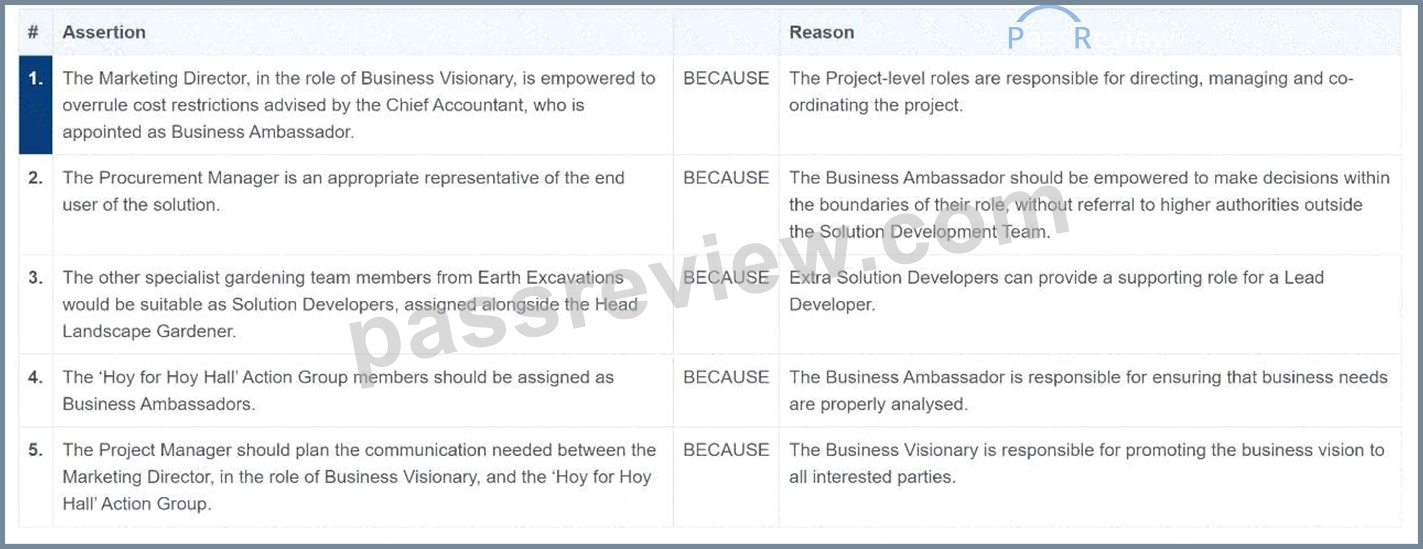
Assertion
* The Marketing Director, in the role of Business Visionary, is empowered to overrule cost restrictions advised by the Chief Accountant, who is appointed as Business Ambassador.
BECAUSE
The Project-level roles are responsible for directing, managing and co- ordinating the project.
* The Procurement Manager is an appropriate representative of the end user of the solution.
BECAUSE
The Business Ambassador should be empowered to make decisions within
the boundaries of their role, without referral to higher authorities outside the Solution Development Team.
* The other specialist gardening team members from Earth Excavations would be suitable as Solution Developers, assigned alongside the Head Landscape Gardener.
BECAUSE
Extra Solution Developers can provide a supporting role for a Lead
Developer.
* The 'Hoy for Hoy Hall' Action Group members should be assigned as Business Ambassadors.
BECAUSE
The Business Ambassador is responsible for ensuring that business needs are properly analysed.
* The Project Manager should plan the communication needed between the Marketing Director, in the role of Business Visionary, and the 'Hoy for Hoy Hall' Action Group.
BECAUSE
The Business Visionary is responsible for promoting the business vision to all interested parties.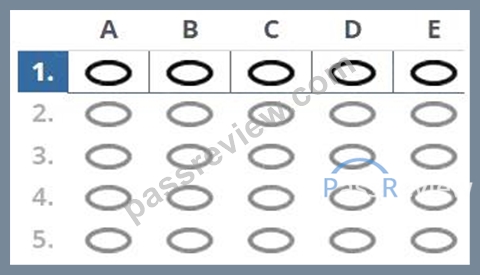
Answer:
Explanation: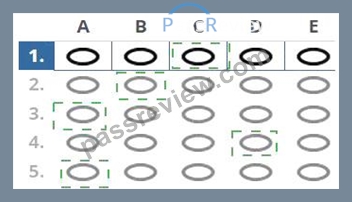
Explanation:
Here are the appropriate options for each assertion and reason combination:
* The Marketing Director, in the role of Business Visionary, is empowered to overrule cost restrictions advised by the Chief Accountant, who is appointed as Business Ambassador.
* C. True (Assertion) False (Reason)
* Rationale: While the Business Visionary may have the authority to make strategic decisions that could overrule cost restrictions, the reason given relates to project-level roles directing the project, not to the authority to overrule cost-related advice.
* The Procurement Manager is an appropriate representative of the end user of the solution.
* B. True (Assertion) True (Reason) BUT the reason does not explain the assertion
* Rationale: The Procurement Manager, as part of the operational team, could represent the end user. However, the reason given talks about the empowerment of the Business Ambassador, which does not directly explain why the Procurement Manager is a representative of the end user.
* The other specialist gardening team members from Earth Excavations would be suitable as Solution Developers, assigned alongside the Head Landscape Gardener.
* A. True (Assertion) True (Reason) AND the reason explains the assertion
* Rationale: Specialist gardening team members would be suitable as Solution Developers, providing support to the Lead Developer, which is a common practice in Agile teams.
* The 'Hoy for Hoy Hall' Action Group members should be assigned as Business Ambassadors.
* D. False (Assertion) True (Reason)
* Rationale: While the Business Ambassador should ensure that business needs are analyzed, the
'Hoy for Hoy Hall' Action Group members being assigned as Business Ambassadors is not necessarily true as they are external stakeholders and not necessarily equipped to represent the business internally on a project.
* The Project Manager should plan the communication needed between the Marketing Director, in the role of Business Visionary, and the 'Hoy for Hoy Hall' Action Group.
* A. True (Assertion) True (Reason) AND the reason explains the assertion
* Rationale: The Project Manager typically has the responsibility to plan and manage communication between the project team and external stakeholders, and the Business Visionary's role includes promoting the business vision to interested parties, which includes the 'Hoy for Hoy Hall' Action Group.
NEW QUESTION # 71
A difference of opinion on the outcome of an earlier project has created a
'them and us' culture between the Sales Department and the Operations Department.
What action should the Project Manager take to resolve this?
- A. Allow the different skillsets to work independently of one another so as not to create further conflict.
- B. Appoint only those members of staff who are prepared to work collaboratively.
- C. Brief the team and the Business Visionary on the use of an Agile Project Management approach and the requirement to collaborate.
- D. Circulate a copy of the Business Case to all members of the Solution Development Team and project-level roles and invite feedback.
Answer: C
Explanation:
The most effective action the Project Manager should take to resolve the 'them and us' culture between the Sales Department and the Operations Department is:
B: Brief the team and the Business Visionary on the use of an Agile Project Management approach and the requirement to collaborate.
Addressing the cultural divide requires fostering an environment of collaboration and mutual respect. By educating all team members and the Business Visionary about Agile Project Management principles, which emphasize teamwork, collaboration, and collective ownership of project outcomes, the Project Manager can help shift the team's mindset towards a more unified approach. This briefing should highlight the value of diverse perspectives and the importance of working together towards common goals, thus addressing the underlying issues contributing to the 'them and us' culture. Encouraging open communication and collaboration as fundamental components of the Agile approach can help break down barriers and build a more cohesive team.
NEW QUESTION # 72
Answer the following questions about the acceptance criteria within the project.
Decide whether the approach to setting and using acceptance criteria has been applied appropriately and select the response that supports your decision.
During Solution Development Timebox A, a new Health and Safety requirement arises: the front door is required to have wheelchair access. This is a legal requirement and is a Must Have before any staff or general public access can be allowed. The Solution Development Team will work with the Local Planning Authority Officer, the specialist who identified the requirement, to identify further acceptance criteria for Solution Development Timebox A.
Is this an appropriate action related to acceptance criteria?
- A. Yes, because the new requirement needs to be understood, built and delivered in this Timebox.
- B. No, because this new requirement would NOT be included in the original Prioritised Requirements List and therefore does NOT need acceptance criteria to be defined.
- C. No, because the Business Visionary is responsible for defining acceptance criteria.
- D. Yes, because the Local Planning Authority Officer owns the justification for the new requirement.
Answer: A
Explanation:
A: Yes, because the new requirement needs to be understood, built and delivered in this Timebox.
Rationale:
Agile Project Management is adaptable to changes, even late in the development process. The introduction of a new Health and Safety requirement, such as wheelchair access, which is a legal and must-have requirement, needs to be incorporated into the project as soon as it is identified. Working with the Local Planning Authority Officer to define acceptance criteria ensures that the requirement is clearly understood and that the solution developed meets the necessary legal standards. This approach ensures that the team can immediately address the new requirement and integrate it into the current work cycle, aligning with Agile's principle of welcoming changing requirements, even late in development, for the customer's competitive advantage.
NEW QUESTION # 73
......
PDF version of AgilePM-Practitioner exam questions - being legible to read and remember, support customers’ printing request, and allow you to have a print and practice in papers. Software version of AgilePM-Practitioner guide dump - supporting simulation test system, with times of setup has no restriction. Remember this version support Windows system users only. App online version of AgilePM-Practitioner Guide dump -Being suitable to all kinds of equipment or digital devices, supportive to offline exercises on the condition that you practice it without mobile data. Bogged down in review process right now, our AgilePM-Practitioner training materials with three versions can help you gain massive knowledge.
Most AgilePM-Practitioner Reliable Questions: https://www.passreview.com/AgilePM-Practitioner_exam-copyright.html
- Best AgilePM-Practitioner Preparation Materials ???? Pdf AgilePM-Practitioner Exam Dump ???? Study AgilePM-Practitioner Group ???? Download { AgilePM-Practitioner } for free by simply entering ✔ www.pdfdumps.com ️✔️ website ????Study AgilePM-Practitioner Group
- Use APMG-International AgilePM-Practitioner Dumps to Have Great Outcomes In APMG-International Exam ???? Immediately open ✔ www.pdfvce.com ️✔️ and search for ▛ AgilePM-Practitioner ▟ to obtain a free download ☑Certification AgilePM-Practitioner Test Answers
- AgilePM-Practitioner Test Sample Online ⬅ AgilePM-Practitioner Valid Test Duration ???? AgilePM-Practitioner Test Simulator ???? Easily obtain free download of ➽ AgilePM-Practitioner ???? by searching on 「 www.prep4sures.top 」 ✋Latest AgilePM-Practitioner Dumps Free
- Certification AgilePM-Practitioner Test Answers ???? AgilePM-Practitioner Valid Torrent ☯ AgilePM-Practitioner Test Simulator ???? Download ➤ AgilePM-Practitioner ⮘ for free by simply searching on ➤ www.pdfvce.com ⮘ ????Examcollection AgilePM-Practitioner Questions Answers
- Valid AgilePM-Practitioner Exam Pattern ???? Certification AgilePM-Practitioner Test Answers ???? Exam AgilePM-Practitioner Flashcards ???? Search for ➡ AgilePM-Practitioner ️⬅️ and obtain a free download on ➠ www.vce4dumps.com ???? ????Certification AgilePM-Practitioner Test Answers
- AgilePM-Practitioner Valid Torrent ???? Certification AgilePM-Practitioner Test Answers ???? New Exam AgilePM-Practitioner copyright ???? Simply search for ✔ AgilePM-Practitioner ️✔️ for free download on 【 www.pdfvce.com 】 ????Certification AgilePM-Practitioner Test Answers
- Effective AgilePM-Practitioner Guide | Easy To Study and Pass Exam at first attempt - Professional APMG-International Agile Project Management (AgilePM) Practitioner Exam ???? Go to website ▛ www.vceengine.com ▟ open and search for ▛ AgilePM-Practitioner ▟ to download for free ????Exam AgilePM-Practitioner Flashcards
- 100% Pass Quiz 2026 AgilePM-Practitioner: Agile Project Management (AgilePM) Practitioner Exam – High Pass-Rate Guide ???? Copy URL ➤ www.pdfvce.com ⮘ open and search for 【 AgilePM-Practitioner 】 to download for free ????New Exam AgilePM-Practitioner copyright
- Effective AgilePM-Practitioner Guide | Easy To Study and Pass Exam at first attempt - Professional APMG-International Agile Project Management (AgilePM) Practitioner Exam ⤵ Search for 「 AgilePM-Practitioner 」 and download exam materials for free through { www.examdiscuss.com } ⚫Study AgilePM-Practitioner Group
- Pdf AgilePM-Practitioner Exam Dump ???? Examcollection AgilePM-Practitioner Questions Answers ???? AgilePM-Practitioner Test Sample Online ???? Enter 《 www.pdfvce.com 》 and search for ➥ AgilePM-Practitioner ???? to download for free ????Pdf AgilePM-Practitioner Exam Dump
- New Exam AgilePM-Practitioner copyright ⚒ Latest AgilePM-Practitioner Dumps Free ???? Valid AgilePM-Practitioner Exam Pattern ???? Search for “ AgilePM-Practitioner ” and download it for free on ▶ www.torrentvce.com ◀ website ????AgilePM-Practitioner Valid Test Preparation
- letsbookmarkit.com, pr8bookmarks.com, zoeucqo610407.blogsuperapp.com, www.stes.tyc.edu.tw, safiyauyeh756997.tusblogos.com, majaydbp233486.bloginder.com, kathrynqmxh495500.nico-wiki.com, hindibookmark.com, barryrwgi548583.blogvivi.com, www.stes.tyc.edu.tw, Disposable vapes
BTW, DOWNLOAD part of PassReview AgilePM-Practitioner dumps from Cloud Storage: https://drive.google.com/open?id=1AGY0jmNVlC5rYhLKCa16fkzgCj1gTus0
Report this wiki page